
Compounding
How Consistency in Wealth, Career, Learning, and Relationships Can Change Everything

When I first encountered the concept of compounding, it was all about finance—turning small investments into significant returns over time. It’s that classic story: invest a little now, let it sit, and watch it grow. But as I’ve navigated through my career, personal growth, and relationships, I’ve realized that compounding is more than just a financial strategy. It’s a powerful principle that, when applied to different aspects of life, can lead to extraordinary results. Let’s dive into how this principle has worked for me beyond the numbers.
1. Compounding in Wealth: Slow and Steady Always Wins
I began investing early—not because I had a lot to spare, but because I understood the power of time. I set up automatic transfers, contributing what seemed like modest amounts. It felt almost insignificant for years. But the magic of compounding doesn’t lie in immediate rewards; it’s in the slow, steady growth that accelerates over time. The longer you give it, the bigger the payoff.
There were no big gambles, no stock-picking wizardry, just the discipline of staying the course. The result? Financial peace of mind that’s grown far beyond the initial effort. The takeaway? Start early, stay steady, and let compounding do the heavy lifting.
“Compound interest is the eighth wonder of the world. He who understands it, earns it … he who doesn’t … pays it.” - Albert Einstein
2. Career Compounding: Building Skills Brick by Brick
Career growth is another area where compounding works wonders. Early on, I was always searching for the big breakthrough—a promotion, a project that would catapult me forward. But I quickly learned that real progress doesn’t come from big leaps; it comes from small, consistent actions that compound over time.
For me, this meant taking every opportunity to learn: reading articles, picking up new skills, and even just paying close attention during meetings to understand how decisions were made. One of the best habits I developed was dedicating 30 minutes a day to learning something new—whether it was a technical skill, a management technique, or simply exploring a new topic. None of these actions felt transformative in isolation, but over time, they stacked up, creating a competitive edge that set me apart.
The lesson? It’s not about monumental steps; it’s about the accumulation of small, consistent efforts that lead to exponential career growth.
3. Learning: A Lifetime Investment
Learning is another area where compounding has played a huge role in my life. I’ve always been a big believer in continuous learning, not just as a career booster, but as a way to stay adaptable and curious. What I’ve found is that, much like investing money, investing in learning pays dividends far beyond the initial effort.
When I started teaching Generative AI to product managers, it was daunting at first. The subject was complex, and the audience was highly knowledgeable. But instead of trying to master everything overnight, I committed to a consistent learning schedule. I broke down my study into manageable chunks, and day by day, the material became less intimidating. Over time, not only did my understanding deepen, but my ability to teach and communicate these concepts improved significantly.
Whether it’s learning a new skill, keeping up with industry trends, or diving into a passion project, the compounding effect of daily learning can open doors you didn’t even know existed.
4. Relationships: Small Gestures Compound Too
The power of compounding is perhaps most underestimated in relationships. It’s easy to think that strong relationships are built on big moments—celebrations, grand gestures, or major life events. But in my experience, it’s the small, everyday interactions that truly deepen connections. A quick check-in, a kind word, or a shared laugh over coffee—these are the moments that build trust and camaraderie.
There was a period when my work took up almost all of my time, and I noticed my relationships starting to strain. It wasn’t the big missed events that caused the drift; it was the absence of those small, everyday connections. So I made a conscious effort to reconnect through little gestures—sending a thoughtful message, scheduling a catch-up call, or simply being more present. Slowly, those small actions compounded into stronger, more resilient relationships.
In both personal and professional spheres, it’s the consistency of small, positive interactions that compounds into deep, meaningful connections.
5. The Formula Behind It All: Understanding Compounding
So, what exactly is happening when we talk about compounding? Here’s the simple formula that underpins this powerful concept :
A = P(1 + r/n)^(nt)
Where:
A is the amount accumulated after n years, including interest.
P is the principal amount (initial investment).
r is the annual interest rate (as a decimal).
n is the number of times interest is compounded (Typically per year).
t is the time invested.
It’s straightforward in its design but profound in its impact. The formula shows that the growth isn’t just on your principal; it’s on the accumulated interest too. In simple terms, it’s your money making money—or, when applied beyond finance, it’s your effort yielding more than just immediate results. Over time, this creates a snowball effect where the growth becomes exponential, not linear.
Final Thought: Consistency Beats Intensity
The common theme in all these stories is simple: consistency beats intensity. Whether it’s investing, learning, building a career, or nurturing relationships, it’s not the one-off grand gestures that create lasting impact; it’s the steady, consistent actions taken over time.
Life is not about the perfect start or the grand finale; it’s about showing up every day and putting in the work, even when the results aren’t immediately visible. Compounding is the ultimate long game, and its rewards come to those who have the patience and persistence to stay the course.
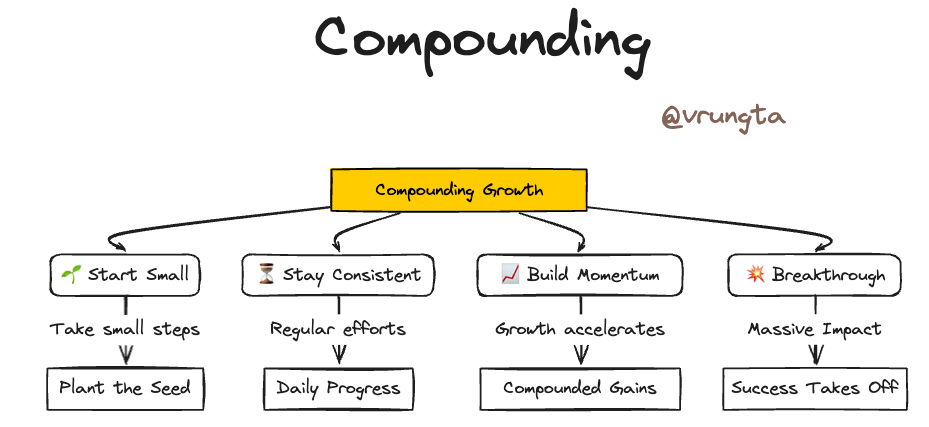
So, where will you start applying the power of compounding in your life? Pick one area—be it your savings, your skills, your learning journey, or your relationships. Start small, stay consistent, and trust the process. Because at the end of the day, it’s not the big moves that get you where you want to be—it’s the small, steady steps that make all the difference.